Tiangong Ultra

Not declared: no public price list. Research and industrial collaboration model, not a sales model (to be verified on a primary source).
- How much it costs
- The manufacturer has not published a price: the figures in circulation are not confirmed by a primary source.
- Can you get it in Italy
- Not planned for Italy.
- What it is for
- Autonomous sorting of industrial components; quality control on electrical panels (opening the cabinet, pressing buttons, operating switches); autonomous transport of objects.
- The limit to know about
- The manufacturer does not publish a spec sheet for Tiangong Ultra: degrees of freedom, battery life and payload are not declared anywhere, while for Tiangong 3.0 and Tiangong Omni they are.
In brief
Chinese humanoid by the Beijing Humanoid Robot Innovation Center (X-Humanoid): the dynamic-performance benchmark (100 m in 8.64 s at the 2026 World Humanoid Robot Games). Research platform, not for sale. Height and weight only “approximately”; degrees of freedom, runtime and payload not published.
Specifications
| Manufacturer | X-Humanoid (Beijing Humanoid Robot Innovation Center) |
|---|---|
| Origin | China |
| Year | n/a |
| Status | Prototype |
| Availability in Italy | Not planned for Italy not published by the manufacturer |
| Access | n/a |
| AI system | Piattaforma «Huisi Kaiwu», dichiarata prima piattaforma generale di intelligenza incarnata («un cervello, molte macchine»); dataset Robomind e ArtVIP; modelli Pelican. |
| Relevance for the home | Low |
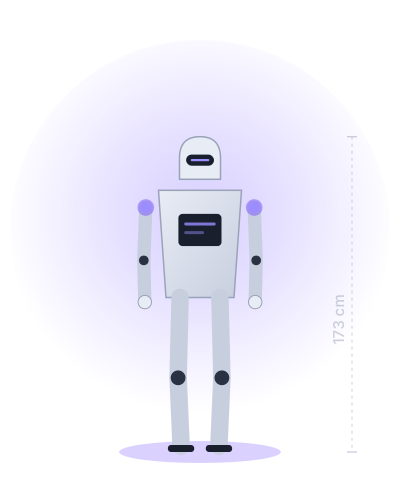
| Height | about 180 cm |
| Weight | about 55 kg |
| Total DOF | n/a not published by the manufacturer |
| Payload (arm) | n/a not published by the manufacturer |
| Battery life | n/a not published by the manufacturer |
Teleoperation & privacy
It is not a consumer product company but a public-private innovation center, with a pre-industrial validation platform open to companies, universities and research institutions. It builds shared platforms and datasets (Robomind, ArtVIP), not a product to sell.
Strengths
Chinese benchmark for dynamic performance: at the 2026 World Humanoid Robot Games in Beijing, 100 m in 8.64 s and a 3.4 m high jump. Open industrial model (public-private center) with shared platforms and datasets (Huisi Kaiwu, Robomind, ArtVIP) and a declared open source community.
Weaknesses
The manufacturer does not publish a spec sheet for Tiangong Ultra: degrees of freedom, battery life and payload are not declared anywhere, while for Tiangong 3.0 and Tiangong Omni they are. Height and weight exist on a primary source but are declared as approximate values in a press release from July 2025. Prototype / research platform, with no sales channel to the public: the declared deliveries go to universities and development partners. No home applications.
What it really does vs. marketing
The center communicates athletic performance measured in public competition — more solid than an on-stage demo, because it takes place under comparable conditions. But running 100 meters and folding a T-shirt are different problems, and the second is the one that matters for the home: they beat human records on speed, not on fine manipulation.
⚠️ Scope: coverage for context and benchmarking. It is not a home robot: the declared applications are industrial and visitor reception. It has a profile because it is the Chinese benchmark for dynamic performance and because our editorial cites it in relation to the World Humanoid Robot Games.
⚠️ Data warning. The manufacturer does not publish a spec sheet for Tiangong Ultra. It declares height and weight, but in a press release and in approximate form (“approximately 180 cm”, “approximately 55 kg”), not in a specifications table. It does not declare degrees of freedom, battery life or payload at all: it publishes them for other models of the same family — Tiangong 3.0 and Tiangong Omni — and those numbers do not apply to Ultra. Here they therefore remain empty, and we do not take them from third-party databases: we prefer an incomplete profile to a profile that looks complete.
Identity
Developed by the Beijing Humanoid Robot Innovation Center (北京人形机器人创新中心), known internationally as X-Humanoid (Beijing, China). It is not a consumer product company but an innovation center, with a pre-industrial validation platform open to companies, universities and research institutions.
Ultra and Tiangong 3.0 are two distinct models of the same family, not two versions of the same robot: the center presents them together as “Embodied Tiangong” and in March 2026 it delivered 9 Ultra and 6 Tiangong 3.0 to universities and development partners. Ultra is the extreme-motion model — high-speed autonomous running, light and rigid body, heat dissipation; Tiangong 3.0 is the general-purpose work platform, the one the center describes with a spec sheet. Alongside the two: Tianyi 2.0 (arms on a wheeled base) and Tiangong Omni (small format, 135 cm and 39.5 kg, 31 degrees of freedom).
Price
Not declared. No public price list: the center's model is one of research and industrial collaboration, not of sales to the public.
Hardware
- Height: approximately 180 cm · Weight: approximately 55 kg. Declared by the manufacturer on its own news center on July 17, 2025, with the word “approximately”: they are indicative values, not a spec sheet.
- Degrees of freedom · battery life · payload: not declared. It is not that we did not find them: the manufacturer does not publish them for this model. Searched on September 24, 2026 on the home page, on all the product pages and in 151 press releases from the news center.
- For Tiangong 3.0 the center claims it is “the industry's first full-size humanoid to achieve whole-body dynamic motion control with contact interaction” (company claim, not independent verification).
Demonstrated performance — official, dated data
From the news center of the official website, August 2026 (second edition of the World Humanoid Robot Games, Beijing):
- August 26, 2026 — Tiangong Ultra: 100 m in 8.85 s, high jump 3.4 m.
- August 27, 2026 — Tiangong Ultra: 8.64 s, title confirmed at the Games.
- August 28, 2026 — closing: 15 golds, 12 silvers, 18 bronzes, first place in the overall medal count (declared by the center).
- September 10, 2026 — the center's recap: in addition to the 100 m, 400 m in 45.66 s, plus 1500 m, 4×100 m relay, high jump, running and standing long jump. In the same note the center claims 34 human records beaten over the course of the Games.
How to read these numbers. They are real performances, verifiable in a public competition, and they deserve recognition: the dynamic locomotion of the best Chinese humanoids is today the most advanced in the world. But running 100 meters and folding a T-shirt are different problems, and the second is the one that matters for the home.
AI / Embodiment
Proprietary platform “Huisi Kaiwu” (慧思开物), presented as the world's first general-purpose embodied intelligence platform, with the principle “one brain, many capabilities · one brain, many machines”. Data platform: Robomind (dataset and benchmark) and ArtVIP (articulated digital assets). Models cited: Pelican-Unify, Pelican 2.0. Declared open source community.
Status and availability
Prototype / research platform. No sales channel to the public is known. Declared applications: sorting of industrial components, quality control on electrical panels, transport of objects, guiding and welcoming visitors in showrooms. Italy / Europe: no indication.
Home and people
Relevance for the home: low. None of the declared applications is domestic. It has a profile as a yardstick for dynamic performance and as an example of an industrial model different from the Western one: a public-private center that builds shared platforms and datasets instead of a product to sell.
Data legend: sensitive fields carry a verification label. “To be verified” means that the data has not yet been confirmed on a primary source.
Sources
- X-Humanoid — official website (news center, August 26-28, 2026) primary source
- X-Humanoid — press release of July 17, 2025: Tiangong Ultra first carrier of the “energy cube” at the Great Wall (contains height and weight) primary source
- X-Humanoid — press release of March 19, 2026: delivery ceremony for the robot half marathon (6 Tiangong 3.0 and 9 Tiangong Ultra to universities and partners) primary source
- X-Humanoid — press release of September 10, 2026: the four “champion products”, with Tiangong Ultra’s 2026 records primary source
Next to each source we state what kind of source it is: “primary source” means the manufacturer, an official document or the author of the data; “press” a news report; “retailer” a distributor or a store, reliable about its own offer — price and availability in Italy — but not about the product’s features; “analysis” a professional firm or a research center that signs its own reading; “Chinese state media” an outlet controlled by the state, whose content should be weighed as such; “blog/forum” a non-editorial source; “unclassified” a source we have not assessed yet: the link stays, the judgment does not.