ZEALS D1
From 5,000,000 ¥ (~32-34,000 dollars, press conversion) + ~¥200,000/month in operating costs. No official EUR/USD price.
- How much it costs
- The manufacturer has not published a price: the figures in circulation are not confirmed by a primary source.
- Can you get it in Italy
- Not planned for Italy.
- What it is for
- Personal assistance in hospitals and care facilities: lifting, carrying and accompanying. Declared targets: hospitals, care facilities, hotels, warehouses.
- The limit to know about
- 110 kg on a wheeled base in a hospital corridor: a safety issue not addressed by the press release. No plan for Europe. First batch of 100 units: long-term reliability cannot yet be assessed. Price on a primary source only in Japanese.
In brief
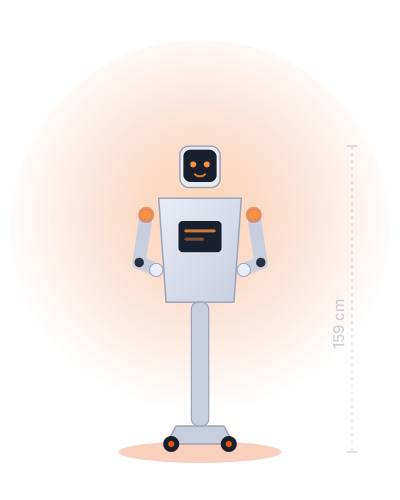
Japanese semi-humanoid by ZEALS for assistance in hospitals and care facilities: two arms on a wheeled base (no legs), ~8 h of battery life and a price half that of the Japanese market. The bet is giving up bipedal walking.
Specifications
| Manufacturer | ZEALS |
|---|---|
| Origin | Japan |
| Year | 2026 |
| Status | Pre-order |
| Availability in Italy | Not planned for Italy ⚠ to be verified |
| Access | Purchase |
| AI system | n/a |
| Relevance for the home | Medium |
| Height | 159 cm |
| Weight | 110 kg |
| DOF per hand | 1 |
| Total DOF | 21 |
| Payload (arm) | 5 kg |
| Speed | 1.0 m/s |
| Battery life | 8.0 h |
Teleoperation & privacy
Wheeled base (AMR) with two anthropomorphic arms, no legs: a deliberate choice for battery life, stability and price. The AI model is not detailed in the press release; the company’s thesis is that the advantage lies in data collected in the field (goal: 10,000 hours of cumulative real-world operation).
Strengths
First humanoid in our database to knowingly give up bipedal walking: ~8 h of battery life (thanks to the wheels), price about half the Japanese market average. Sober communication and consistent numbers. Designed for personal assistance.
Weaknesses
110 kg on a wheeled base in a hospital corridor: a safety issue not addressed by the press release. No plan for Europe. First batch of 100 units: long-term reliability cannot yet be assessed. Price on a primary source only in Japanese.
What it really does vs. marketing
Unusually sober communication: no promise of general autonomy, no demo of household chores. It sells a machine that lifts, carries and accompanies in a hospital corridor, with consistent numbers (5 kg/arm, 1 m/s, ±5 cm) and an explicit business model (machine + operating subscription).
Identity
Made by ZEALS (Japan, Tokyo), it is the company’s first in-house designed humanoid. Presented on August 5, 2026 at a press conference in Tokyo, with a live demonstration, and announced by CEO Masahiro Shimizu. The declared category is “semi-humanoid”: two anthropomorphic arms on a wheeled base (AMR), with no legs. Giving up bipedal walking is a deliberate choice, not a design limitation.
Price
From 5 million yen (about 32,000-34,000 dollars according to the exchange rates reported by the press) — about half the Japanese market average for machines in this category, as declared by the manufacturer — plus about 200,000 yen per month in operating costs. No European price or European distributor indicated.
Hardware
- Height: 129.3 – 159.3 cm (telescopic column; the profile shows the maximum value).
- Base 48 × 55.5 cm, minimum passage 65 cm; weight ~110 kg.
- 21 degrees of freedom: neck (2), arms (7 × 2), grippers (1 × 2), lift (1), base (2).
- Payload 5 kg per arm; AMR wheeled base, top speed 1 m/s, precision ±5 cm.
- Battery life ~8 hours — clearly higher than that of any biped in the database, a direct consequence of choosing wheels.
(Data declared by the manufacturer, not independent measurements; primary source in Japanese.)
Status and availability
Reservations open since August 5, 2026; the first batch (deliveries in October 2026) is reported as already sold out (third-party source). Declared goal: 100 units by fiscal year 2026. No indication for Italy/Europe.
Home and people
It is not designed for private homes, but to assist people in care settings, and it is designed around the real constraints of those spaces (base width, minimum passage of 65 cm, telescopic column to work both at bedside and standing). It is the first humanoid in our database to give up bipedal walking to obtain battery life, stability and a halved price.
Data legend: sensitive fields carry a verification label. “To be verified” means that the data is not yet confirmed on a primary source.
Correction of October 19, 2026: we removed some statements about data handling and safety features that are not supported by the manufacturers’ pages read on October 19, 2026.
Sources
- ZEALS — official press release (PR Times, August 5, 2026) primary source
- ZEALS — official website primary source
- robotstart.info (third-party source) press
Next to each source we state what kind of source it is: “primary source” means the manufacturer, an official document or the author of the data; “press” a news report; “retailer” a distributor or a store, reliable about its own offer — price and availability in Italy — but not about the product’s features; “analysis” a professional firm or a research center that signs its own reading; “Chinese state media” an outlet controlled by the state, whose content should be weighed as such; “blog/forum” a non-editorial source; “unclassified” a source we have not assessed yet: the link stays, the judgment does not.