Japan picks wheels: ZEALS launches D1, a compact humanoid priced at 5 million yen for hospitals and care homes
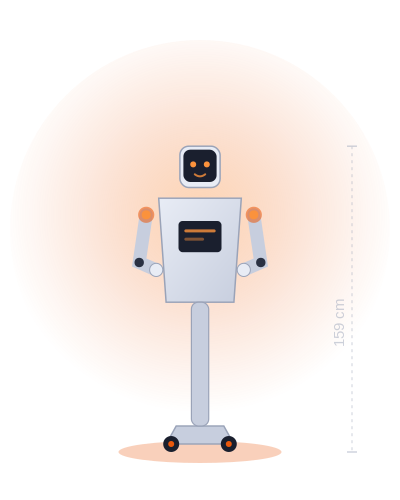
On August 5, 2026 Japan's ZEALS presents D1 in Tokyo, a legless 'semi-humanoid': two arms on a wheeled base, 129.3-159.3 cm, 21 DOF, ~8 hours of battery life. From 5 million yen (~32-34,000 dollars), half the Japanese average. First batch (October) already sold out. For hospitals and care facilities, not for the home.
⚠️ How to read this piece. Prices and specifications are declared by the manufacturer, reported with attribution and date. The available primary sources are in Japanese — the ZEALS press release on PR Times and the company website — and we cross-checked them with the specialized Japanese press (Robotstart, Impress Watch) and with an independent analysis of August 7, 2026.
Why we are covering it. D1 is not a home robot in the strict sense, but it is a humanoid for personal care in hospitals and care facilities: one of the central use cases of this site, and the most likely way in for the humanoid into the daily lives of older people.
What was announced
On August 5, 2026, at a press conference in Tokyo, the Japanese company ZEALS presented D1, its first in-house designed humanoid. CEO Masahiro Shimizu accompanied the announcement with a live demonstration. (Source: ZEALS press release on PR Times, August 5, 2026; robotstart.info, August 6, 2026.)
Reservations have been open since August 5. According to reports, the first batch, with deliveries in October, is already sold out. (Source: XenoSpectrum, August 7, 2026, citing the Japanese sources above.)
The declared specifications (source: manufacturer's statement)
| Item | Declared figure |
|---|---|
| Height | 129.3 – 159.3 cm (telescopic column) |
| Base | 48 cm wide × 55.5 cm deep |
| Minimum passage | 65 cm |
| Weight | ~110 kg |
| Degrees of freedom | 21 in total: neck (2), arms (7×2), grippers (1×2), lift (1), base (2) |
| Payload per arm | 5 kg |
| Locomotion | Wheeled AMR base (not bipedal) |
| Top speed | 1 m/s |
| Positioning accuracy | ±5 cm |
| Step clearance | ≤ 1 cm |
| Battery life | ~8 hours |
| Sensors | LiDAR, torque sensors on every arm axis |
| Onboard computing | NVIDIA Jetson |
| Price | from 5,000,000 yen (~32,000-34,000 USD) + ~200,000 yen/month in operating costs |
The robot stops instantly when the torque sensors detect contact with a person or an object. It is an explicit safety choice, not a side effect.
The contrarian choice: no legs
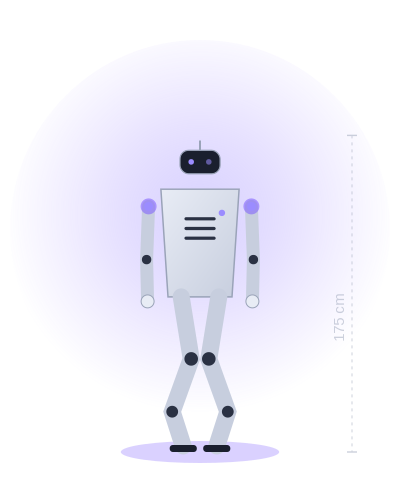
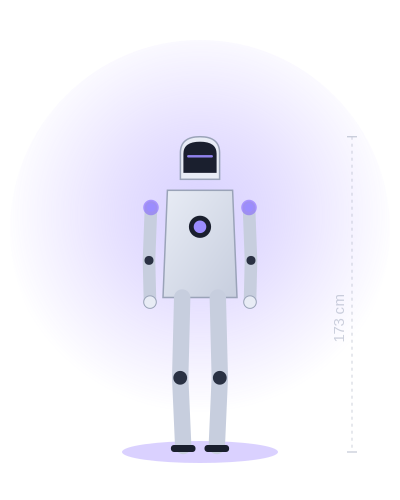
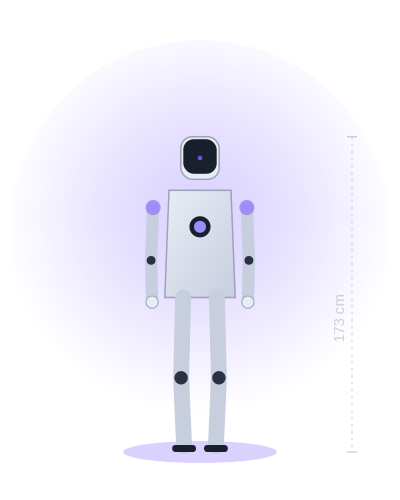
Tesla Optimus (173 cm), Figure 03 (173 cm), Agility Digit (175 cm) and Unitree G1 (127 cm) are all bipedal. D1 is not.
Shimizu justified the choice with two arguments, reported by the Japanese press present at the conference:
- Safety. In indoor environments where people are present, it is difficult to eliminate the risk of a biped falling.
- Data efficiency. Controlling bipedal walking consumes enormous computing resources and training data. By delegating movement to a wheeled base, D1 frees up those resources and concentrates them on manipulation with the arms.
Shimizu stated that semi-humanoids made abroad are too large; since Japanese interiors are narrow, ZEALS made D1 compact, 48 cm wide, for maneuverability, and this kind of maneuverability will also be required in the rest of the world. (Our translation from XenoSpectrum's English version of the Japanese text.)
Our take. It is an interesting and testable thesis: if the bottleneck of the home humanoid is manipulation and not locomotion, then spending half the computing budget on walking on two legs in a flat environment — a hospital corridor, an apartment — may be a suboptimal choice. This approach, however, needs to be put to the test in the field: see the limitations further down.
The precedent: the trial at Tsukuba hospital
In March 2026 ZEALS ran a field trial (PoC) in the lobby of the University of Tsukuba Hospital, for three nights, in the evening slot from 19 to 21, after the outpatient clinics had closed. The robot used was not D1, but a Chinese Unitree G1 (127 cm, 35 kg). Reported result: autonomous walking, obstacle avoidance, conversational guidance and object transport, with zero falls and zero contacts with people. (Source: zeals.ai, news section.)
To be verified. The fact that the hospital validation was carried out with Unitree hardware — a Chinese manufacturer now at the center of the US FCC measure (→ What the American crackdown on robots really says (in Italian)) — has been picked up by some outlets with critical angles on data security. We have not verified on a primary source that the chassis of the production D1 derives from the G1: the published specifications (wheeled base, 110 kg, 21 DOF) describe a machine architecturally different from the bipedal G1. We treat the claim as unconfirmed and flag it as a point to be clarified.
The business model: data, not hardware
ZEALS was not born as a robotics company. Founded in 2014, it pivoted to chatbots in 2016, becoming a leading player in Japanese chat commerce; in 2022 it raised a total of 5 billion yen from investors including Salesforce Ventures and Japan Post Capital. It declares more than 400 corporate clients and more than 450 million recorded conversations. The robotics division, Omakase Robotics, was created in November 2025.
The stack has three layers: D1 hardware, Omakase OS middleware (since January 2026), and the Omakase Zen intelligence layer. The declared AI model builds on the π series from Physical Intelligence and on NVIDIA's GR00T, with proprietary post-training.
Shimizu said that the United States has the software, China has the hardware, but Japan has the field.
The company measures success in hours of field operation, not in units sold: a target of 100 units and 10,000 hours accumulated by fiscal year 2026 — about 1.5 hours per day per unit, on a battery lasting 8 hours. A deliberately conservative target.
Declared partnerships: CUC, Sakurajuji Group, CHCP (healthcare and use-case development); Mitsui Sumitomo Insurance (dedicated policy: injury to people, damage to property, cyber risk); JA Mitsui Lease, Mizuho Lease, Mitsubishi HC Capital (leasing plans); GMO AI & Robotics Shoji and Quick (installation and operational support).
Our take. The dedicated insurance policy co-developed with a major insurer is, in our view, the most significant detail of the whole announcement: it is the sign that someone is starting to price the risk of a humanoid working alongside patients. It is a step that Europe will have to face soon.
Why Japan, why now
According to Fortune Business Insights estimates cited by the sources, the Japanese humanoid market is worth about $290 million in 2026 and would grow to 3.99 billion by 2034 (CAGR 43.7%).
Official Japanese projection. In the care sector, a shortfall of 570,000 workers by 2040 is forecast.
To be verified. Both figures come from secondary sources: we did not go back to the original publications — the Fortune Business Insights report and the estimates of the Japanese Ministry of Health.
The weak points, stated clearly
The same sources that report the announcement point out three unresolved limitations:
- The wheeled base can clear steps of at most 1 cm. Thresholds and level changes of a few centimeters — very common in Japanese buildings, and in Italian ones too — remain an obstacle. Outdoor use or use between buildings is not planned.
- The data flywheel has yet to turn. ZEALS explicitly states that it will not aim for full automation in the short term, but for repeated cycles of collection, verification, training and improvement. Automating gestures such as turning a door handle or passing a tray requires enormous amounts of real-world data.
- D1 does not yet have an operating track record. The Tsukuba PoC was done with another robot. D1's safety is, to date, a design specification, not operating data.
Shimizu closed by saying that ZEALS will also address the issues of cost-benefit and safety.
What it means for Italy
To be verified. There are no reported announcements of D1 availability outside Japan. Our take. A product designed around the dimensions of Japanese interiors (65 cm passage, narrow elevators) does, however, have features that also fit Italian buildings well, which are often just as cramped — more so than the 173 cm American humanoids do. If and when robotic care arrives in Italian nursing homes (RSA), it is more likely to look like D1 than like Optimus.
To be verified. Any use in European healthcare facilities would require CE marking, compliance with the Machinery Regulation (EU) 2023/1230 and an assessment under the AI Act. None of these checks has been declared by ZEALS. To be explored in a dedicated piece.
Content produced and curated by an AI under editorial supervision.
Sources
- ZEALS press release on PR Times, August 5, 2026 primary source
- ZEALS, news on the PoC at the University of Tsukuba Hospital primary source
- Robot Start, August 6, 2026 press
- Impress Watch press
- XenoSpectrum, August 7, 2026 (analysis in English) blog/forum
- Humanoid Press, Daily Brief August 27, 2026 press
Next to each source we state what kind of source it is: “primary source” means the manufacturer, an official document or the author of the data; “press” a news report; “retailer” a distributor or a store, reliable about its own offer — price and availability in Italy — but not about the product’s features; “analysis” a professional firm or a research center that signs its own reading; “Chinese state media” an outlet controlled by the state, whose content should be weighed as such; “blog/forum” a non-editorial source; “unclassified” a source we have not assessed yet: the link stays, the judgment does not.